Dropped object: falling shim plate while lowering A-frame
- Safety Flash
- Published on 3 March 2026
- Generated on 19 June 2026
- IMCA SF 04/26
- 2 minute read
During the lowering of the A-frame of the crane on a large crane vessel, a plate with a weight of 15kg, rolled out from the auxiliary inboard fleeting sheaves.
What happened?
The shim plate fell 15m onto the roof of the crane cabin. On hearing the noise, work was stopped. The drop zone and surrounding areas were secured to ensure safe conditions. Had the plate hit anyone, there would have been a fatality.
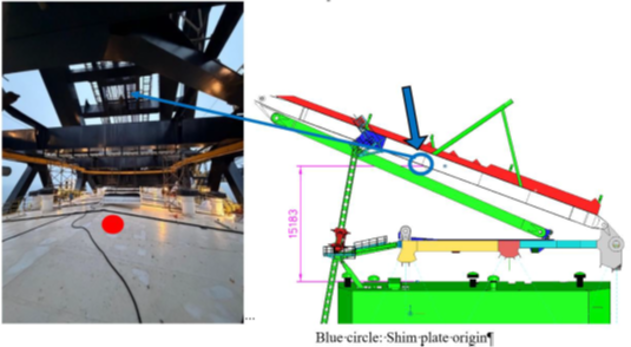
What went wrong?
Investigation showed that these plates were not secured at all, and that only by luck, had they not fallen off during previous operations.
- The shim plate had been installed in 2014, when the A-frame did not have the ability to be lowered.
- In 2021 the A-frame had been modified, to have the ability to be lowered.
- During routine maintenance of the fleeting sheaves in 2025, the shim plates were removed and cleaned.
- After the re-installation the shim plates were not secured, as this had never been the case before.
- During previous operations shim plates remained in place by luck.
Further investigation revealed that there was no Failure Mode and Effect Analysis (FMEA), Failure Mode Effect and Criticality Analysis (FMECA) or dropped object study/analyses conducted prior to the lowering of the A-frame.
The investigation concluded that the shim plates did not become dropped objects earlier only because of the accumulation of dirt and corrosion holding them in place.
There was a thorough inspection of subsequent securing of all shim plates on both crane A-frames.
What to do now?
- Check carefully - could there be other similar components at risk of becoming a dropped object?
- Design review: are there other similar components which might be affected by the increase or decrease of crane inclination angles?
- Consider: the absence of incidents does not necessarily imply a safe work environment.
Related Safety Flashes
-
IMCA SF 21/15
7 December 2015
-
IMCA SF 09/21
30 March 2021
-
IMCA SF 15/14
8 September 2014
IMCA Safety Flashes summarise key safety matters and incidents, allowing lessons to be more easily learnt for the benefit of the entire offshore industry.
The effectiveness of the IMCA Safety Flash system depends on the industry sharing information and so avoiding repeat incidents. Incidents are classified according to IOGP's Life Saving Rules.
All information is anonymised or sanitised, as appropriate, and warnings for graphic content included where possible.
IMCA makes every effort to ensure both the accuracy and reliability of the information shared, but is not be liable for any guidance and/or recommendation and/or statement herein contained.
The information contained in this document does not fulfil or replace any individual's or Member's legal, regulatory or other duties or obligations in respect of their operations. Individuals and Members remain solely responsible for the safe, lawful and proper conduct of their operations.
Share your safety incidents with IMCA online. Sign-up to receive Safety Flashes straight to your email.