High potential incident – Man injured while falling overboard (MOB)
- Safety Flash
- Published on 6 December 2019
- Generated on 27 October 2026
- IMCA SF 28/19
- 3 minute read
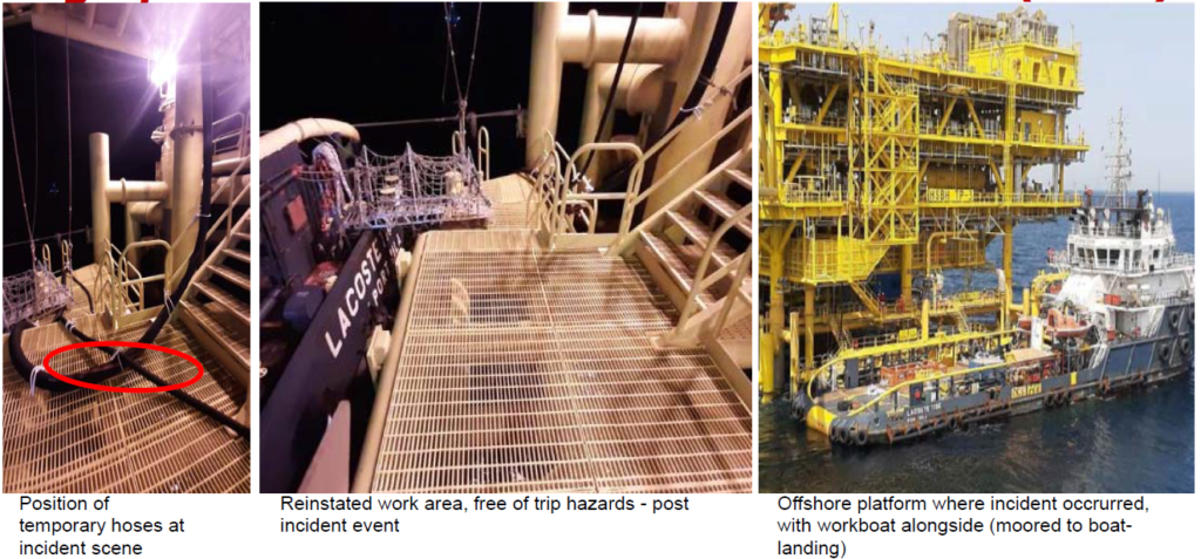
Whilst descending stairs to a boat-landing area on an offshore platform, a sub-contracted employee of one of our Members tripped on a 2-inch discharge hose that had been laid across the base of a stairway.
What happened?
The employee fell forward onto the boat landing, momentarily arresting his forward movement, before tumbling into the gap between the boat landing and a moored workboat. He was able to break his fall by grabbing a fender chain attached to the workboat.
The employee was injured by the fall (it was a restricted work case) - however, it is clear that there was potential for the outcome to be more severe.
The officer on watch witnessed the incident from the vessel bridge and raised the alarm; a deck AB responded by manually recovering the partially submerged person to deck. He was wearing a three-piece foam flotation device, and all required personal protective equipment (PPE) including a helmet with chinstrap correctly worn.
He suffered bruising to the left wrist and a minor cut to the right ear. Follow up medical examination indicated that he also suffered a fractured wrist.
What went wrong? What were the causes?
- The incident was the result of poor/inadequate hose management practices; Hoses were laid across the platform boat-landing causing a trip hazard.
- Control measures as per the approved risk assessment were not implemented; specifically, the requirement to route hoses in a safe manner. This resulted in poor worksite preparation and insufficient inspection.
- Poor custom and practice – laying hoses on platform walkways had been common practice during the current campaign; they had been temporarily set up four days prior to incident and they were not identified or highlighted as causing a trip hazard.
- Failure to recognise and report hazards – individuals involved in the operations at the time of the incident had previously accessed the platform’s boat landing and had failed to recognise and report the hazards presented from hoses laid across walkways.
What actions were taken?
- Ensure all work tasks are adequately planned and risk assessed before starting work activities, including review of access, egress and escape routes.
- Where temporary hoses are placed at access ways/work areas always, consider additional controls to eliminate the possibility for trip hazards, such as use of cable racks or hose covers.
- Increase focus on critical safety behaviours such as ‘eyes on path’ when accessing unfamiliar worksites. When hazards and/or unsafe conditions are observed, intervene and report.
Featured Safety Flashes
-
IMCA SF 04/09
2 April 2009
-
IMCA SF 14/14
7 August 2014
-
IMCA SF 14/14
7 August 2014
IMCA Safety Flashes summarise key safety matters and incidents, allowing lessons to be more easily learnt for the benefit of the entire offshore industry.
The effectiveness of the IMCA Safety Flash system depends on the industry sharing information and so avoiding repeat incidents. Incidents are classified according to IOGP's Life Saving Rules.
All information is anonymised or sanitised, as appropriate, and warnings for graphic content included where possible.
IMCA makes every effort to ensure both the accuracy and reliability of the information shared, but is not be liable for any guidance and/or recommendation and/or statement herein contained.
The information contained in this document does not fulfil or replace any individual's or Member's legal, regulatory or other duties or obligations in respect of their operations. Individuals and Members remain solely responsible for the safe, lawful and proper conduct of their operations.
Share your safety incidents with IMCA online. Sign-up to receive Safety Flashes straight to your email.