LTI: Leg injury while using hand-held grinder
- Safety Flash
- Published on 18 December 2025
- Generated on 2 April 2026
- IMCA SF 23/25
- 2 minute read
A worker suffered a leg injury whilst using a hand-held grinder.
What happened?
A worker suffered a leg injury whilst using a hand-held grinder. The incident occurred when the worker was cutting wood with a wood-cutting disc installed. On the third cut, the grinder slipped from his hand, fell to the floor, and bounced back, hitting his right calf. The worker’s supervisor was able to quickly switch off the power, and the worker was taken to the hospital for treatment.
This incident caused a deep cut about 10 cm long, damaging muscle and tendon, and fracturing the bone, which required surgery and a metal pin.
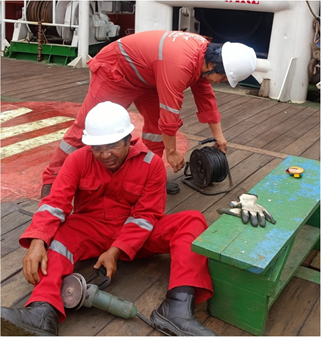
Reconstruction
What went right?
- The supervisor quickly switched off the grinder’s power, preventing further injury.
- First aid was immediately applied to control the bleeding, which helped stabilize the injured person.
- The injured person was transferred to the hospital within minutes, enabling timely surgery and reducing complications.
- The supervisor informed the Master and Operations Manager quickly, ensuring proper reporting and coordination.
- At the time of the incident the injured person was fit for duty (healthy, rested and free from alcohol or drugs).
What could have prevented the incident from occurring?
- Using the right tool for the right job: a hand-held grinder, even with a wood cutting disc installed, has the high risk of kicking back. Better, safer, more appropriate tools could have been made available.
- Discussion of the hazards of using a grinder for wood cutting could have been part of the toolbox talk – in this case, it wasn’t discussed.
- Not feeling “perceived” pressure to get the job done quickly: the crew naturally wanted to complete the job quickly, so instead of using a hand saw, they chose to use a handheld grinder.
Lessons to learn
- Take time to think through the task before starting. Challenge the usual thinking. Are we really saving time by doing the job this way rather than doing it the safe way?
- Use the right tool for the right job.
Related Safety Flashes
-
IMCA SF 33/21
2 December 2021
-
-
IMCA SF 28/16
18 October 2016
IMCA Safety Flashes summarise key safety matters and incidents, allowing lessons to be more easily learnt for the benefit of the entire offshore industry.
The effectiveness of the IMCA Safety Flash system depends on the industry sharing information and so avoiding repeat incidents. Incidents are classified according to IOGP's Life Saving Rules.
All information is anonymised or sanitised, as appropriate, and warnings for graphic content included where possible.
IMCA makes every effort to ensure both the accuracy and reliability of the information shared, but is not be liable for any guidance and/or recommendation and/or statement herein contained.
The information contained in this document does not fulfil or replace any individual's or Member's legal, regulatory or other duties or obligations in respect of their operations. Individuals and Members remain solely responsible for the safe, lawful and proper conduct of their operations.
Share your safety incidents with IMCA online. Sign-up to receive Safety Flashes straight to your email.