Finger burnt by overheating electrical component
- Safety Flash
- Published on 11 April 2018
- Generated on 26 October 2026
- IMCA SF 08/18
- 2 minute read
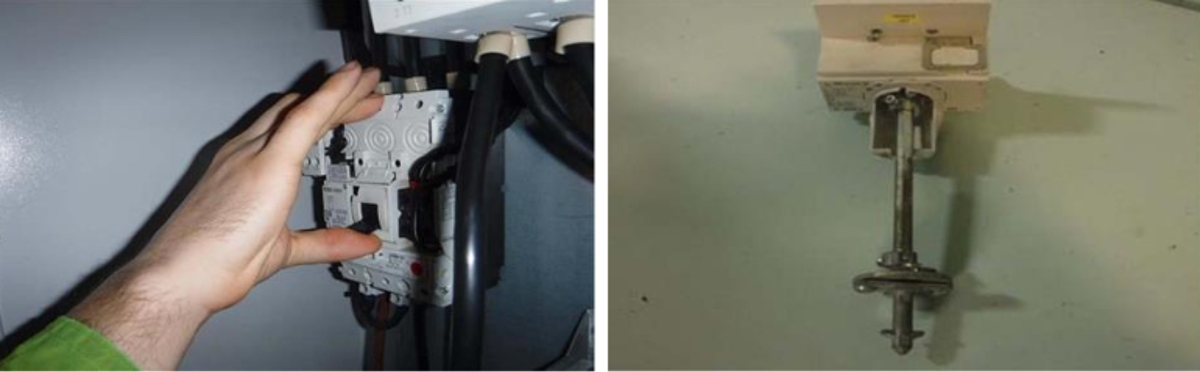
The Marine Safety Forum (MSF) reports an incident in which a worker on a vessel was working on the operating panel for a 690 VAC anti-heeling pump, when he received a burn to his middle finger.
What happened?
He got burnt when he reset the breaker switch. This resulted in a first aid case and he was treated on board.
What went wrong? What were the causes?
It was noted that:
- No work or maintenance was being carried out on the inside of the cabinet, so there was no permit to work or isolation (the breaker was the method of isolation).
- The breaker was never ‘live’ – the burn was due to the heating of the breaker due to it being of an incorrect rating. This was confirmed afterwards through numerous simulations and calculations.
The MSF member noted the following causes:
- Rotary isolation switch within the electrical cabinet was broken and had been removed.
- There had been a failure to follow defect reporting procedure.
- Due to a missing isolation switch, direct contact had to be gained internally to reset breaker.
- There was a lack of hazard awareness and risk perception.
- There was a lack of consideration for safety devices.
What actions were taken? What lessons were learned?
- A new rotary isolation switch was fitted to the breaker switch.
- All similar cabinets on board were checked and rotary switches fitted as required.
- A full onshore investigation was initiated due to the perceived potential severity of the incident.
- Upon further investigation, it was found that a change in the cable length after the cabinet from the system design to actual build meant that the breaker was insufficient and had a tendency to heat up. This cable was also replaced.
Please see the short IMCA safety video Electrical hazards
Related Safety Flashes
-
IMCA SF 33/16
6 December 2016
-
IMCA SF 04/15
20 March 2015
IMCA Safety Flashes summarise key safety matters and incidents, allowing lessons to be more easily learnt for the benefit of the entire offshore industry.
The effectiveness of the IMCA Safety Flash system depends on the industry sharing information and so avoiding repeat incidents. Incidents are classified according to IOGP's Life Saving Rules.
All information is anonymised or sanitised, as appropriate, and warnings for graphic content included where possible.
IMCA makes every effort to ensure both the accuracy and reliability of the information shared, but is not be liable for any guidance and/or recommendation and/or statement herein contained.
The information contained in this document does not fulfil or replace any individual's or Member's legal, regulatory or other duties or obligations in respect of their operations. Individuals and Members remain solely responsible for the safe, lawful and proper conduct of their operations.
Share your safety incidents with IMCA online. Sign-up to receive Safety Flashes straight to your email.