Vessel mast struck bridge – equipment damage
- Safety Flash
- Published on 28 March 2017
- Generated on 3 September 2026
- IMCA SF 07/17
- 3 minute read
A Member has reported an incident in which the aft mast of a vessel struck an overbridge and broke, damaging the navigation lights on the mast.
What happened?
The incident took place during a transit of a ship canal in the United States.
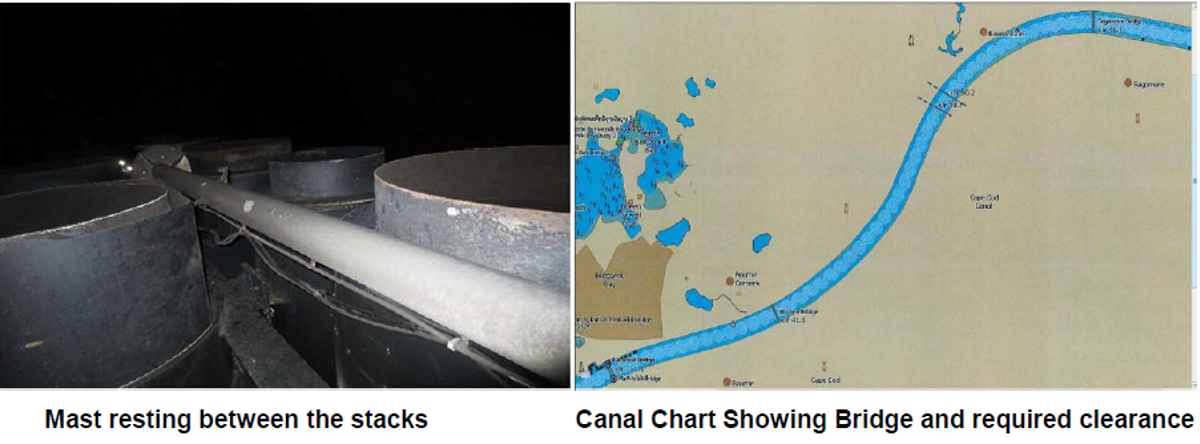
The aft mast of the ship struck the lower span of a raised vertical lift railway bridge.
The aluminium mast post broke just above the base. As a result, the navigational lights on the mast post were damaged beyond repair.
The mast fell safely on the funnel top and no persons were injured. The local United States Coast Guard (USCG) Captain was notified of the incident and the vessel continued to its next port of call, where repairs were conducted.
Findings
- Causal factors:
- Inadequate procedures – incorrect air draft used in Pilot-Master exchange, Pilot Card, Ship Particulars and Manoeuvring Poster.
- Vessel not operated as per company procedures.
- Inadequate communication – previously identified concerns relating to the transit through the canal were either not disseminated to current staff or were not taken into consideration during transit.
- Inadequate procedures – incorrect air draft used in Pilot-Master exchange, Pilot Card, Ship Particulars and Manoeuvring Poster.
- Root Cause:
- Confusing, contradictory or incomplete management system – vessel documents contradictory and partly incorrect with regards to air draft.
- Enforcement issue – shipboard management failed to enforce proper use of company procedures.
- Confusing, contradictory or incomplete management system – vessel documents contradictory and partly incorrect with regards to air draft.
- The bridge team were not familiar with their own company procedures or manuals, and when asked, took quite some time to locate it (hard copy or electronic version).
- The air draft for the vessel had not been calculated. A predetermined static figure was used and compared with the height of whatever structure they would be transiting under.
- The static figure used was the air draft of the vessel in summer conditions, even keel and with mast lowered. This figure was used as air draft on the Pilot Card and confirmed verbally between the Pilot and the Master. No mention was made of the need to lower any mast.
- The General Arrangement Plan posted on the bridge clearly indicates that the figure for air draft must be with the mast down. However, other documentation contradicted this, and no-one on the crew could provide any clarification.
- It was known by members of the previous crew that to allow the vessel to pass safely, there would need to be ideal tidal conditions and the mast would have to be lowered. It appears that this information was not passed to the bridge team.
In summary, there was incomplete planning of the voyage, inadequate communications, and a lack of understanding or proper assessment of all the risks involved. Of particular note is the fact that vessel air draft is a dynamic figure and should be calculated on a case-by-case basis.
IMCA Safety Flashes summarise key safety matters and incidents, allowing lessons to be more easily learnt for the benefit of the entire offshore industry.
The effectiveness of the IMCA Safety Flash system depends on the industry sharing information and so avoiding repeat incidents. Incidents are classified according to IOGP's Life Saving Rules.
All information is anonymised or sanitised, as appropriate, and warnings for graphic content included where possible.
IMCA makes every effort to ensure both the accuracy and reliability of the information shared, but is not be liable for any guidance and/or recommendation and/or statement herein contained.
The information contained in this document does not fulfil or replace any individual's or Member's legal, regulatory or other duties or obligations in respect of their operations. Individuals and Members remain solely responsible for the safe, lawful and proper conduct of their operations.
Share your safety incidents with IMCA online. Sign-up to receive Safety Flashes straight to your email.