Improper use of tools: bruising
- Safety Flash
- Published on 29 June 2011
- Generated on 24 October 2026
- IMCA SF 05/11
- 2 minute read
A Member has reported an incident in which a crewman was injured whilst using a power tool in an incorrect manner.
What happened?
A crewman on night shift was required by the chief engineer to clean paint and corrosion off of the nuts on man-hole covers, so that the covers could be removed for inspection. He was instructed to perform this task using either a hand-held wire brush or a 4 inch angle grinder fitted with a wire wheel.
These instructions were verbally acknowledged by the crewman, who had been employed on the vessel for nearly a year. Nonetheless he decided to use a 5mm grinding disk on the angle grinder instead of the wire wheel, and then proceeded to cut the threads off the bolts on the man-hole cover.
As the grinding disk was being used in an incorrect manner, the disk jammed causing the grinder to deflect into his shoulder, cutting his boiler suit and causing bruising and a minor abrasion.

inspection hatch being prepared
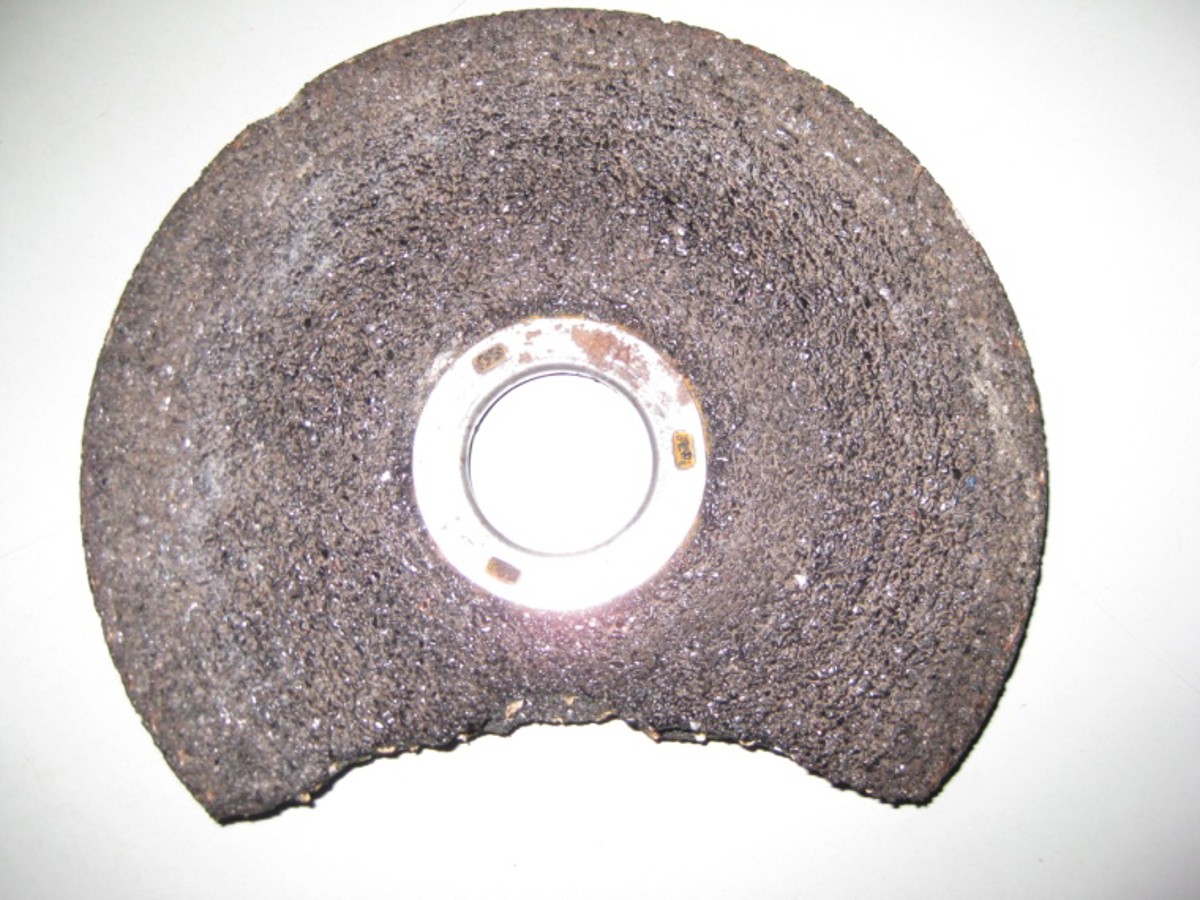
broken grinding disk after inappropriate use
What were the causes?
An investigation noted that:
- Existing company procedures and clear instructions were not followed.
- Risk assessments had not been completed.
- The individual involved in the operation demonstrated a lack of safety awareness that put himself, his colleagues and the vessel at risk.
- The individual involved in the operation had received no training in this specific task.
Lessons learnt
The following lessons were learnt from the incident:
- Complacency with regard to the use of power tools must be guarded against.
- All persons involved in a task, from deck officers and supervisors to deck crew, should have a clear understanding of the nature of the task and their duties with regard to the task.
- All crew should have a deeper understanding of the requirement for risk assessment for all ‘routine’ and non-‘routine’ tasks.
- All crew members should be reminded of the importance of accepting personal responsibility for safety and that they all are empowered to stop work until safe operations are restored.
- Shipboard training and familiarisation should include specific training in particular tasks and equipment.
IMCA Safety Flashes summarise key safety matters and incidents, allowing lessons to be more easily learnt for the benefit of the entire offshore industry.
The effectiveness of the IMCA Safety Flash system depends on the industry sharing information and so avoiding repeat incidents. Incidents are classified according to IOGP's Life Saving Rules.
All information is anonymised or sanitised, as appropriate, and warnings for graphic content included where possible.
IMCA makes every effort to ensure both the accuracy and reliability of the information shared, but is not be liable for any guidance and/or recommendation and/or statement herein contained.
The information contained in this document does not fulfil or replace any individual's or Member's legal, regulatory or other duties or obligations in respect of their operations. Individuals and Members remain solely responsible for the safe, lawful and proper conduct of their operations.
Share your safety incidents with IMCA online. Sign-up to receive Safety Flashes straight to your email.