Umbilical support frame made contact with passing vehicle on public road
- Safety Flash
- Published on 22 January 2026
- Generated on 3 April 2026
- IMCA SF 02/26
- 2 minute read
Whilst travelling, a contractor transporting umbilical support frames (USFs) made contact with a passing vehicle as one of the frames dropped down.
What happened?
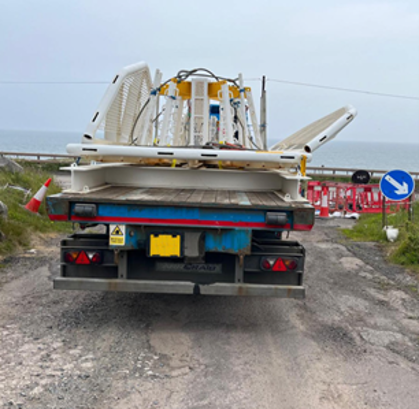
A third party contractor had collected two umbilical support frames (USFs) from a vessel and was transporting them on a public road. Whilst travelling, the right side of one of the frames dropped down and made contact with a passing vehicle.
Details as to what happened to the other vehicle are not known but IMCA infers that it suffered only minor damage and no persons were injured.
What went wrong?
- The frame was not provided as per drawing/specification – the transportation brackets were missing.
- Upon arrival at the vessel the wings had been stropped together. Although transport brackets had been indicated in the drawings, they were not present when the equipment was delivered.
- There were pins that had to be inserted into the frame, and there was an assumption that these would hold the wings in an upright position for transportation.
- There was no process/procedure to ensure that equipment was going out as per original drawings;
- There was no instruction provided as to how to secure the USF for transportation, neither internally nor to the third party transportation company.
- On departure from the vessel, the load was secured to the trailer but the wings were not stropped.
What happened next - actions
- Ensure that equipment is provided and received with relevant up to date drawings/specifications.
- Ensure equipment is properly marked with instructions – these frames were subsequently stencilled so it is clear to all parties that the wings need to be secured.
- Ensure that de-mobilisation planning meetings are conducted to confirm tasks and equipment are understood.
- That self-verifications at project mobilisations/de-mobilisations are conducted;
- That there is an understanding of the equipment being handled, and,
- That written instructions are available where appropriate.
- Provide clear instruction to all personnel involved in the movement of equipment – do not assume quayside support workers are familiar with specialist marine or offshore equipment and how it is operated.
Related Safety Flashes
-
IMCA SF 09/18
24 April 2018
-
-
IMCA SF 15/24
31 July 2024
-
-
IMCA SF 12/25
3 July 2025
-

IMCA Safety Flashes summarise key safety matters and incidents, allowing lessons to be more easily learnt for the benefit of the entire offshore industry.
The effectiveness of the IMCA Safety Flash system depends on the industry sharing information and so avoiding repeat incidents. Incidents are classified according to IOGP's Life Saving Rules.
All information is anonymised or sanitised, as appropriate, and warnings for graphic content included where possible.
IMCA makes every effort to ensure both the accuracy and reliability of the information shared, but is not be liable for any guidance and/or recommendation and/or statement herein contained.
The information contained in this document does not fulfil or replace any individual's or Member's legal, regulatory or other duties or obligations in respect of their operations. Individuals and Members remain solely responsible for the safe, lawful and proper conduct of their operations.
Share your safety incidents with IMCA online. Sign-up to receive Safety Flashes straight to your email.